Could Your Home Be Increasing Family Stress Without You Realising?

At Emma Merry Styling, we have always believed good interior design goes far beyond aesthetics. A beautifully designed home should not only look considered and elevated, but feel emotionally supportive for the people living within it.
Increasingly, one conversation has naturally become part of how we approach family home renovation projects: neurodiversity.
For those new to the term, neurodiversity refers to the different ways people process, learn, behave and experience the world. It is an umbrella term that can include ADHD, autism, dyslexia and dyspraxia.

Whilst I don’t believe neurodiversity should become the sole narrative of a design scheme, I do believe every successful home begins with understanding the people who live there. The most thoughtful interiors quietly support family life in ways that often go unnoticed day-to-day.
Growing up in the 80s and 90s, there was far less language around these differences. I remember family members describing somebody as “sensitive to noise”, “particular about organisation”, or needing “everything in its place”. Today, thankfully, we have a far deeper understanding of how environments can influence emotional regulation, concentration and overall wellbeing within the home.
And honestly? In our family, neurodiversity is very much woven into everyday life. An aunt once described our family as being “rife with it” from dyslexia to ADHD and over the years I’ve realised how much this has subconsciously shaped both the way we live and the way we now design homes as a studio.
For the past five years, we’ve quietly integrated questions around routines, sensory preferences, family dynamics and lifestyle habits into our onboarding process. Not to overanalyse, but because these small insights often influence some of the most important design decisions later in a renovation project.
Designing Homes Around How Families Actually Live
As a neurodiverse person myself, I know I sit firmly in the “calm home” camp. I’m not someone who thrives with excessive visual clutter, constant background noise or spaces that feel overstimulating.
Fresh air, natural light and visual order are hugely important to how I regulate. In fact, even in winter, our windows and doors are usually open every morning for at least thirty minutes.
When renovating a family home, these are exactly the kinds of habits worth paying attention to.
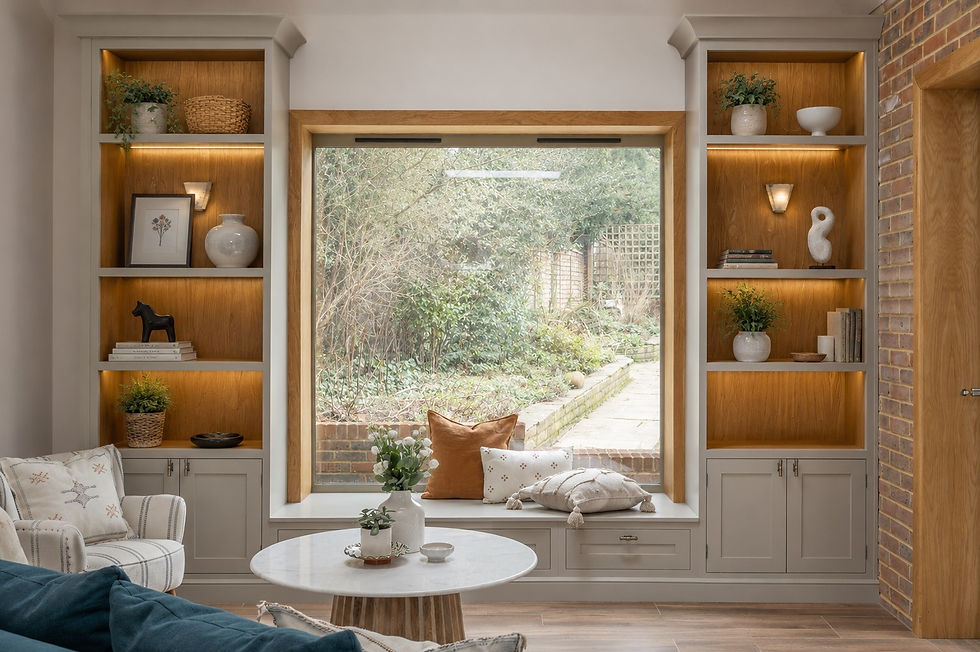
If being connected to the outdoors helps calm your nervous system, perhaps your quiet morning corner should sit beside large steel-framed doors overlooking the garden. Maybe your bedroom needs layered natural textures, soft lighting and generous airflow rather than heavy finishes and visual noise.
The best interior design decisions often come from understanding how you want your home to make you feel , not simply how you want it to look. This growing shift towards emotionally responsive interiors is something increasingly shaping modern renovation projects.
Why Emotional Regulation Matters In Home Design
One project that has always stayed with me involved a young boy who would retreat to the shower twice a day. Initially, his parents assumed it was simply routine, but once we explored it further, we realised the running water was actually helping him regulate emotionally.
He called it his “thinking tank”.
So rather than designing a purely functional family bathroom, we designed around that need. We introduced a built-in bench seat within the shower, allowing him somewhere comfortable to sit, think and decompress.
Such a small architectural adjustment, but one that completely changed how the space supported him emotionally.
Another example sits within my own kitchen renovation. One of my sons often needs physical proximity and reassurance when approaching new tasks, homework, school projects or even building Lego. Unsurprisingly, these moments usually happen whilst I’m trying to cook dinner.
When designing our kitchen, I intentionally created what we now call the “hot seat” at the island. Positioned away from the hob and sink but still close enough for interaction, it includes integrated charging points and a comfortable perch where he can sit whilst I cook.
It allows connection without chaos.

On paper, these details may seem like common sense. But in reality, they only happen when someone takes the time to ask the right questions during the design process.
Neurodiverse-Friendly Interior Design Ideas For Family Homes
I sometimes feel modern life encourages us to constantly purchase another organiser, gadget or storage solution in the hope it will somehow “fix” family overwhelm.
In reality, thoughtful interior design is usually about creating systems and spaces that genuinely support the people using them.
Below are a few simple ideas we regularly apply within both our own home and our client renovation projects.
1. Replace & Remove
This is one of my favourite household habits.
If I use something broken, rusted, stained or no longer functioning properly, a baking tray, storage container or mixing bowl , I immediately add it to a running “Replace” list on my phone.
Then, once a week, I either order replacements online or pick them up whilst out sourcing.
It sounds incredibly simple, but reducing tiny daily frustrations creates far more calm within a home than people realise. Functional homes regulate better because the environment works with you, not against you.
2. Create A “Random Box”
This is brilliant for busy family homes, particularly with neurodiverse children.
Within utility rooms and boot rooms, we often design dedicated baskets or cubby storage for each child. School kit, football boots and swimming bags all have designated zones but we also include one labelled “Random”.
At the end of the day, all the miscellaneous abandoned items around the house get placed into that child’s basket.
The next morning becomes:“Go and check your random box.”
It sounds simple, but it dramatically reduces stress, lost items and unnecessary family friction during busy mornings.

3. Introduce Personal Charging Stations
This is one of the most appreciated additions within our family home renovation projects.
Technology battles are relentless within modern households disappearing chargers, borrowed cables and constant negotiations over devices.
So now, wherever possible, we create personalised charging stations for each family member. Integrated drawers, labelled cables, multiple USB points and designated charging zones instantly remove a huge amount of daily frustration.
Clients message us constantly after moving back in saying the same thing:“It’s stopped so many arguments.”
The Future Of Family-Centred Interior Design
Designing for neurodiversity is not about creating clinical or overly prescriptive interiors. Nor is it about trying to “solve” behaviours through design.
It is simply about recognising that every family experiences home differently. The most successful homes are the ones that feel layered, restorative, functional and emotionally supportive, spaces that reduce overwhelm rather than contribute to it. Much like the wider move towards thoughtful, sensory-led interiors, today’s best homes are balancing practicality with warmth, texture and calm.
At its heart, good interior design should help people feel better within their everyday lives.
And for us, that will always be the most important part of designing a family home.


Comments